
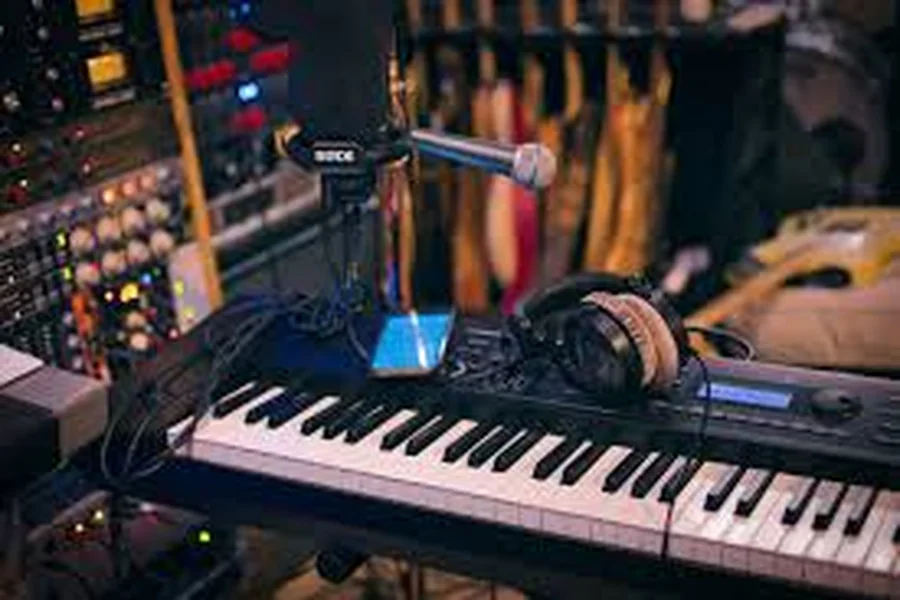
You hear your favorite song and it’s sounding so smooth. However, from a little idea to that completed song, there are a lot of surprises! Making music is a world of late nights, happy accidents and serious technical work. This side is not seen by most people. They listen to the finished product and believe that it just occurred. Come let me show you that place.
The Recording Studio Is More Than a Room
A cool cool recording studio in pictures. Large mixing desks, beautiful shinies microphones and soundproof walls. However, it’s the feeling of the room that truly brings the magic. Entering the inside of time changes. There’s a sense of time that seems like hours turn into minutes. There is a lot of concentration in the air. All corners can be used for a reason.
Control room is the seat of the producer and engineer. The recording session is visible to them, but the viewing is done through thick glass. This glass isn’t all about looks. Helps to prevent sound passing from room to room. The live room is the room where the musicians play. The walls of that space are specially-shaped. The sound waves are scattered by those shapes. They prevent echoing and spoiling the take.
The best studios, however, have an intangible sort of energy, though. They have old worn carpet and strange decorations, worn chairs. These things are important because music is emotional! COLD Sterile Room = COLD Sterile Music. A personalized warm room welcomes true emotion. A lot of hit songs came out of places that were seemingly cluttered. That was a sound part of that mess.
The Producer’s Role Is Often Misunderstood
Most people believe it’s an all-clicks affair. That is wrong. The producer is analogous to a movie director. They have a good overview. They assist artists to get their optimum performance. They differentiate their awareness of what is needed from what is not.
A good producer is able to push and pull. They listen to the artist’s “hearing”. Guitar part may be slightly out of time. Vocal may be lacking in energy. Even the producer is aware of these things, but does not crush the artist’s spirit. It’s a dance of a delicate nature.
The budget and schedule are also controlled by producers. Studio time is real time – real money. I have failed to spend a lot of hours trying to accomplish a weird idea, and instead taking time off of the main song. The producer is a person who manages to incorporate the practical with the creative. They help to carry the session forward. They guard the artist from going through endless takes. The “90:10” rule of many producers is that 90 percent of the work is done in their minds and 10 percent in their hands.
Tracking Instruments Takes Patience and Skill
The act of recording each instrument is called ‘tracking’. This process takes time longer than you would expect. It can take a drummer two hours to get the Micro Locations just right. The drummer has his/her own microphone. Each of the kick drum, snare drum and toms have a microphone. There are overhead mics for cymbals, too. This is eight to twelve mics for one drummer.
Then it’s the bass player’s turn. The engineer may have a direct connection with the bass amp. There was also a microphone on the amp cabinet. Later, they combine the two sounds. Guitars are similar. Three microphones can be used at the same time with an electric guitar. There are two different tonal sounds to each mic. The best one will be selected by the producer later.
This is where the wait is important. The same part may be performed fifty times by a musician. There’s a slight thing that is wrong with each take. The producer hears each and every take. These are their best times. They take five different takes to create one track that’s perfection. That is referred to as comping. It’s something that happens more than artists would want to admit. Repairs are not only behind the scenes of the music production, they are also invisible.
Vocal Recording Is an Emotional Journey
It is different to recording vocals than it is to record guitar. A guitar does NOT get nervous. Guitar doesn’t feel insecure. However, a singer takes his/her whole heart to the microphone. That’s gorgeous and challenging as well.
The vocal booth is NOT a big room. All the walls are lined with soundproof foam. Within this small space with a singer has to sing pure emotion. They are not able to move around much since the microphone has to be at a definite distance. They have headphones to listen to the accompaniment music. Those headphones also enable them to listen to themselves! Some singers don’t like that sound! They prefer reverb and/or delay in their headphones for comfort.
A vocal session can be something like a roller coaster! The singer does the first take and it’s perfect! If they don’t then they won’t be able to do it for the next two hours. The producer keeps a level head and is supportive. They may also lower the illumination. They can try to get the singer to recall a particular memory. They may even go as far as to sit down in the control room with the singer.
The best vocal takes are usually when the singer slows down – they are not trying so hard. Can’t hear the song but feel it and loosen up, something special happens. Hence the need for producers to make all the notes. Not only the warm up takes, Even the mistakes. A few of those errors remain as the final draft.
Mixing Turns Raw Tracks into a Song
Once you have tracked, it’s time to mix. Now it’s time to get into the nitty-gritty of music production. There are between 50 and more than 50 separate audio tracks fed into the mixer. There are individual sounds for each track. One track that has just one kick drum. One for snare top. One for bottom of snare drum. One for bass DI. One for bass amp. Multiple guitar tracks. Lead vocal. Backing vocals. And many more.
All these sounds are balanced by the mixer. Some of them they turn upside down and some they turn inside out. Balance is the beginning and the end isn’t it? They add equalization which is used to give the tone shape. A vocal may require a greater amount of high frequencies to get the clarity it needs. A guitar may require less bass so as not to clash with the bass.
Then comes compression. The volume peaks are controlled by the compression. One moment, the singer can be quiet and the next, loud. That’s a compression that smooths that out. It allows the performance to fit in the song well. Over compression is death to life. If there is not enough compression it will leave tracks that are uneven. It’s a natural gift of good mixers.
The effect reverb and delay, gives space. Reverb is a sound that appears to be in a room. An epic sound is achieved when the vocal is played in a large reverb. A small drum room will result in a tight drum sound. Delay creates echoes. Special care can be taken on a guitar to make it sound wider if there is a delay. The mixer takes hours and hours to fine-tune these effects until everything is in harmony.
Mastering Gives the Final Polish
Music is ready to go out to the world after the mastering process. The final stereo mix is done by a mastering engineer. They do not effect any changes to instruments. They use the entire song as a single sound file.
The overall loudness is checked by the mastering engineer. They ensure that the song is sounding good on any system. A song should be great on a cell phone speaker, a giant club speaker and a car speaker. This is not as easy as it sounds. All speakers have their own strengths and weaknesses. The engineer balances the song with equalization for all those instances.
These also include the final compression and limiting. This increases the volume of the song to stream it. Again, though, it’s all about balance. If it’s too loud, the song will sound squashed and tired. The song is too quiet when played next to other songs. A quality master’s voice is loud but not overpowering and sharp.
Mastering engineers can sequence albums, too. They call the rests in the songs. They ensure that the music transitions from one track to another. This work is fine work. Most listeners won’t be able to hear it. However, without mastering an album sounds like amateur and inconsistent.
Frequently Asked Questions
How long does it take to produce one song?
A professional song can take anywhere from one week to six months. Simple songs with few instruments are faster. Complex songs with many layers and fixes take longer. Most of that time is not recording. It is mixing and making small adjustments.
Do artists really sing every note perfectly?
Almost never. Most modern vocal tracks are tuned with software like Auto-Tune or Melodyne. The singer performs their best take. Then the engineer corrects small pitch errors. Some artists use heavy Auto-Tune as a style effect. Others use it so lightly you cannot hear it.
What is the most expensive part of music production?
Studio time and mixing engineers cost the most. A good studio charges hundreds of dollars per hour. A top mixing engineer charges thousands per song. But home studios have changed everything. Many hit songs are now made in bedrooms with affordable gear.
Can I produce music without knowing music theory?
Yes. Many producers work by ear. They click notes into a piano roll until something sounds good. But knowing basic theory saves time. It helps you understand why some chords feel sad or happy. You do not need a degree. A little knowledge goes a long way.
Why do producers use so many microphones on one drum?
Each microphone captures a different part of the drum sound. The kick drum mic gets the thump. The snare mic gets the crack. The overhead mics get the whole kit’s air and space. Blending these mics gives control. You can turn up the snare without turning up the cymbals.
Final Thought
The behind the scenes of music production is a mix of art and problem solving. It is not glamorous most of the time. It is long hours listening to the same four seconds over and over. It is frustration when a sound won’t sit right. It is joy when a vocal take gives you chills. The next time you hear a song you love remember the invisible work. The tiny edits the brave performances the hard choices at 2 AM. That is where the real music lives. Not on the streaming screen but in the messy beautiful space between the first idea and the final master.
