
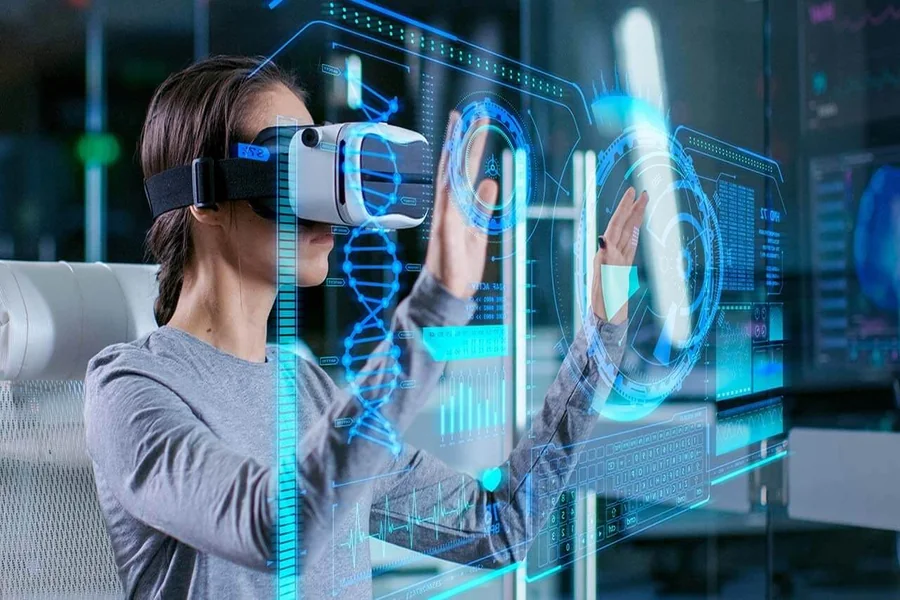
The first VR headset puts you in the world. You’re in a game more than just a spectator. It’s something that took decades to get right. It didn’t happen in one night that the world of immersive virtual reality games evolved. It began on the clunky machines, with wild dreams. You can interact and touch digital objects today! Tomorrow you may not know the difference between real and virtual. This is a trip loaded with clever individuals, botched ventures and stunning successes. So let’s take a walk down memory lane. Where we are going next and.
The Humble Beginnings of VR Gaming
Morton Heilig was the man who envisioned a cinema that would engage all of your senses, long before the advent of the Oculus or HTC Vive. The Sensorama was built by him in 1962. This machine resembled an arcade machine. You settled to watch short films in a viewer, with your face inside. The Sensorama provided you with wind vibrations, stereo sound and smells. Well, it wasn’t a game per se. It put a seed down in her though. Heilig wanted to completely immerse you. He did not make any money out of his invention. However, all VR headsets owe him a silent gratitude.
Then there was the first “real” head mounted display. The Sword of Damocles was invented in 1968 by Ivan Sutherland and his student Bob Sproull. As the name implies, it’s just about exercise. This hanging from the ceiling was too heavy, to wear. You saw the floating simple wireframe forms in a dark space. Your head would turn with the movement. It was a giant leap! However, after several minutes the device had squashed your shoulders. But Still Sutherland made his point. There could be a virtual world in a helmet. It was simply a matter of equipment.
Gaming made a leap into the 1980s. Atari considered VR, but never launched anything. Then a little firm called VPL Research appeared on the scene. The term “virtual reality” was coined by Jaron Lanier who worked there. His team invented both the Eyephone headset and Data Glove. They’re very expensive. They were off limits to all but the rich hobbyists and researchers. However, you could just wave your hand and see a digital version of it in front of you. For the first time your body became the controller. The future of virtual reality gaming, one that was much more immersive, had found its heart. There was no longer a need for a joystick. It required your two hands of your own.
The 1990s: A False Start for Virtual Reality
VR was going to be in every home in the 1990’s. Magazines featured humans wearing “futuristic” helmets on their heads and the happy expressions on their faces. With the arcades they received enormous VR pods. Sega announced a headset to be used with its Genesis console. Nintendo’s Virtual Boy is launched. VR was the expected takeover. It did not happen.
Sega’s headset was never released in the stores. It displayed it at the trade shows. But the technology proved disappointing. Lack of speed in motion tracking. Screens looked blurry. Players were feeling sick after 5 minutes. The project was finally quietly abandoned by Sega. The Virtual Boy was even worse! It was a portable 3D system, Nintendo said. A red viewfinder was peering at you, atop a stand. Only the colors red and black were used for graphics. It hurt your eyes. It caused you to have a headache. It’s not like it was very immersive either. You were seated at a table, looking in a box. The Virtual Boy was an epic flop. After less than a year Nintendo discontinued the production of it.
Arcade VR was having a more successful outing. You can stand in a ring in front of machines such as the Virtuality system and wear a heavy headset and hold a plastic gun. Fight robots, or fly a space ship. These machines enable you to pay thousands of dollars. The price of playing was $10 for 10 minutes. The images appeared to be cuboid-shaped. However, there were many people who lined up to try. You could splash around in an actual 3D space. It was like magic! Unfortunately the magic wasn’t to last. For home consoles, higher graphics for less money. VR remained too much of a hassle and too costly. It became “fad of the month. VR was dismissed as a “dead end,” by critics.
The 1990’s have been a lesson. If you don’t feel well you are not getting the immersion. Any headset should be light and quick. The screens must be high resolution and with low delay. All these were missing during the 1990s. However, this dream did not go away. Some scientists continued to research. They understood that they would all unite one day.
The Modern Renaissance of Immersive Gaming
All this changed in the 2010s. Palmer Luckey was a young inventor that developed VR headsets in his parents’ garage. He enjoyed getting his hands dirty on old VR equipment but disliked how poor it was. Hence, he decided to use some spare phone parts to make his own. His prototype was more successful than million dollar lab equipment. He began a Kickstarter for the Oculus Rift. Gamers went wild. The campaign saw millions raised in one day. VR was suddenly on the scene again.
Facebook acquired Oculus for two billions of dollars. It left the tech community in for a shock. Mark Zuckerberg was considered to be crazy. But He foresaw the future. He realized that VR can take the place of all of your screens in your life. The Oculus Rift was finally released in 2016. It was equipped with a high-resolution screen with precise tracking and built-in headphones. You might be able to peer around corners and lean forward. You could use touch controllers to touch objects and grab virtual objects. This was no trick. This was real.
Then competition arrived. HTC teamed up with Valve to make the Vive. The Vive was your room scale VR. You could go around a space and view your walls as ghost. It was so wonderful to be free. PlayStation VR has teamed up with Sony. All of a sudden, millions of console owners could experience immersive gaming. In the world of video games, VR has taken a leap forward into the future with immersive play. New and improved headsets each year! Higher resolution. Broader views of the landscape. Wireless options. Hand tracking. Eye tracking.
A Quest headset is now available for $300. You slide it on and no wires inhibit you. Drawing in mid air. Climb Mountains. Table tennis is available for people to play with strangers from Japan. The games are virtually realistic. And the best part? You don’t need to buy any external cameras. The headset is self-tracking with micro cameras built into the front of the headset. This is the dream that the ’90s magazines used to promise. It just only took 30 more years to come.
Key Technologies Driving VR Evolution
So how has VR become so awesome and in such a short amount of time? There were three technologies that advanced the evolution. First mobile phone screens to be displayed. Smartphones enabled us to have high density small screens for a bargain. VR headsets adopted such screens and gave them an even higher speed. Second motion tracking. The IMUs are tiny sensors which can be used to determine your head turns with great accuracy and for a small price. Outside-in tracking with laser or infrared will afford you Room scale accuracy. Now inside-out tracking is based on the room that is viewed with cameras. No set up is required.
The third, and most important, is computer graphics. The latest GPUs will be able to render two decent pictures 90 times a second. It’s a tremendous amount of power. However it’s a piece of cake for the graphics cards of today. There are new tricks such as foveated rendering that only sharpens the area you’re looking at. The rest of the image remains unclear. That will lower the power consumption and enable headsets to work on a phone chip. This is shown to be true with the Quest.
Another huge improvement was made to haptics. Buzzed” is the term used to describe the way an old controller operated. New ones have both finger tracking and force feedback. Feel the “rain” or a hard “punch”. Certain gloves will allow you to experience texture. Some suits allow the player to feel a hand on his/her shoulder. These are still high cost tools. However, they will be available at a more reasonable price. After a couple of years your entire body could come alive to the game world.
The jump of another magnitude is inside-out tracking. This eliminates all of the external sensors. Your headset scans your room, maps the furniture and keeps track of your location. Does not trip when walking around. If you’re approaching a wall, the headset will display a blue grid. This is the simple concept that enabled VR to be mobile. You can play in the living room, and then bring the headset to a friend’s home to play. No setup time. No cables. No hassle.
Wireless streaming also revolutionized the way. It’s now possible to play PC games wirelessly. Your computer processes the game, and sends it to your headset via Wi-Fi. The lag time is too short to be noticeable. This is a powerful gaming PC that is also portable. What can be accomplished can be seen in the games such as Half-Life Alix. Collect bottles, throw them around and shoot alien monsters. Any action is natural as it is your real hands.
Final Thought
So how has VR become so awesome and in such a short amount of time? There were three technologies that advanced the evolution. First mobile phone screens to be displayed. Smartphones enabled us to have high density small screens for a bargain. VR headsets adopted such screens and gave them an even higher speed. Second motion tracking. The IMUs are tiny sensors which can be used to determine your head turns with great accuracy and for a small price. Outside-in tracking with laser or infrared will afford you Room scale accuracy. Now inside-out tracking is based on the room that is viewed with cameras. No set up is required.
The third, and most important, is computer graphics. The latest GPUs will be able to render two decent pictures 90 times a second. It’s a tremendous amount of power. However it’s a piece of cake for the graphics cards of today. There are new tricks such as foveated rendering that only sharpens the area you’re looking at. The rest of the image remains unclear. That will lower the power consumption and enable headsets to work on a phone chip. This is shown to be true with the Quest.
Another huge improvement was made to haptics. Buzzed” is the term used to describe the way an old controller operated. New ones have both finger tracking and force feedback. Feel the “rain” or a hard “punch”. Certain gloves will allow you to experience texture. Some suits allow the player to feel a hand on his/her shoulder. These are still high cost tools. However, they will be available at a more reasonable price. After a couple of years your entire body could come alive to the game world.
The jump of another magnitude is inside-out tracking. This eliminates all of the external sensors. Your headset scans your room, maps the furniture and keeps track of your location. Does not trip when walking around. If you’re approaching a wall, the headset will display a blue grid. This is the simple concept that enabled VR to be mobile. You can play in the living room, and then bring the headset to a friend’s home to play. No setup time. No cables. No hassle.
Wireless streaming also revolutionized the way. It’s now possible to play PC games wirelessly. Your computer processes the game, and sends it to your headset via Wi-Fi. The lag time is too short to be noticeable. This is a powerful gaming PC that is also portable. What can be accomplished can be seen in the games such as Half-Life Alix. Collect bottles, throw them around and shoot alien monsters. Any action is natural as it is your real hands.
Frequently Asked Questions
What was the first VR headset for gaming?
The first true VR headset for gaming was the EyePhone from VPL Research in 1989. But it cost huge money and barely worked as a game device. For home gaming fans the Sega VR prototype in 1991 was the first real attempt. Sadly Sega never released it to stores.
Why did VR fail in the 1990s?
VR failed in the 1990s because the technology was not ready. Headsets weighed too much. Screens offered low resolution and slow refresh rates. Motion tracking drifted and lagged. Players got motion sickness fast. Also the games looked ugly and simple. People paid a lot for a bad experience so they never came back.
Is VR gaming good for your brain?
VR gaming can improve spatial awareness reaction time and problem solving. Some studies show it helps with memory and learning. But too much VR might cause eye strain or temporary balance issues. Playing in short sessions with breaks is the smart way. Always stop if you feel dizzy.
What is inside-out tracking?
Inside-out tracking means your headset uses built-in cameras to see the room around you. It looks at furniture walls and your own hands. Then it figures out exactly where you are without any external sensors. This makes setup fast and portable. The Oculus Quest series uses inside-out tracking perfectly.
Do I need a powerful computer for modern VR?
It depends on your headset. Standalone headsets like the Quest store and run games on the headset itself. No computer needed. PC VR headsets like the Valve Index need a gaming computer with a strong graphics card. Check the headset specs before you buy. A mid-range gaming PC can run most VR games fine.
What is foveated rendering?
Foveated rendering uses eye tracking to only sharpen the exact spot you look at. Everything in your side vision stays blurry. This saves massive computer power. Your eyes never notice the blur because human side vision is already blurry. This trick lets mobile chips run high-end VR games.
Will VR replace traditional gaming?
VR will not replace traditional gaming. It will live beside it like movies and TV live together. Some games feel better on a screen. Strategy games and fast shooters still work great on a monitor. But immersive games like horror puzzles and social experiences are much stronger in VR. Both styles have their place.
How long will current VR headsets last?
A good VR headset can last three to five years before you feel the need to upgrade. New models arrive every year or two. But the improvements are getting smaller. A Quest 2 from 2020 still plays almost every new game fine. Just take care of the lenses and controllers. They are the most delicate parts.
